The Challenge
India has one of the highest burdens of drug-resistant tuberculosis (DR-TB)*. Under National TB Elimination Programme (NTEP) guidelines, all persons with TB are to undergo Line Probe Assay (LPA) testing for drug-resistance.
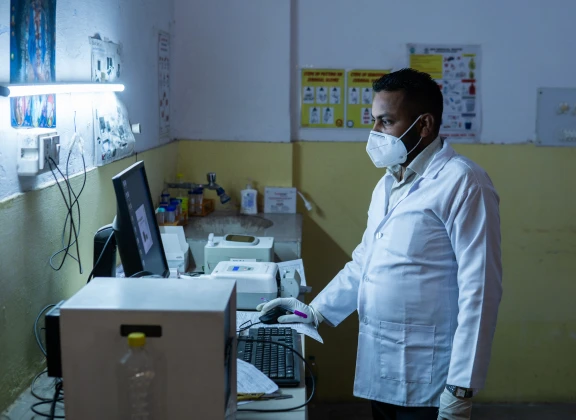
India conducts approximately 4.5 lakh LPA tests annually. However, lab staff spend substantial time on data-related administrative and interpretation tasks: according to the Digital Infra-workflow survey, approximately five hours per median workload are spent on paper-based data entry (2.5 hours), MIS entries (1.5 hours), and LPA results interpretation (1 hour).
Our AI Solution
Line Probe Assay Automation is an AI solution that uses computer vision to automate the reading, interpretation, and transmission of LPA test results, with real-time data integration into the Ni-kshay portal.
The model was developed using LPA sheet data provided by the Central TB Division (CTD), collected from TB laboratories, with expert annotations from lab technicians and microbiologists across multiple Intermediate Reference Laboratories (IRLs), and benchmarked against a curated Gold Standard dataset in collaboration with CTD and reference laboratories.
How it works
 01
LPA strip acquisition
laboratory staff run the standard molecular diagnostic LPA test; results are scanned or photographed for AI processing.
LPA strip acquisition
laboratory staff run the standard molecular diagnostic LPA test; results are scanned or photographed for AI processing.
 02
Strip localization
the system identifies and isolates individual LPA strips from the scanned sheet using computer vision.
Strip localization
the system identifies and isolates individual LPA strips from the scanned sheet using computer vision.
 03
Band detection
detection algorithms identify the presence or absence of specific markers on each strip.
Band detection
detection algorithms identify the presence or absence of specific markers on each strip.
 04
Analysis and mapping
the AI tool compares band patterns against reference templates and classifies the drug resistance profile using deterministic decision rules.
Analysis and mapping
the AI tool compares band patterns against reference templates and classifies the drug resistance profile using deterministic decision rules.
 05
Optical Character Recognition (OCR)
an integrated OCR model captures and logs test details directly, reducing data entry errors.
Optical Character Recognition (OCR)
an integrated OCR model captures and logs test details directly, reducing data entry errors.
 06
Human-in-the-loop
ambiguous or low-confidence interpretations are automatically flagged for validation by lab technicians or microbiologists.
Human-in-the-loop
ambiguous or low-confidence interpretations are automatically flagged for validation by lab technicians or microbiologists.
Where It's Deployed
Rolled out in phases, integrated within the Ni-kshay portal.
Impact
Automated LPA interpretation helps enable early detection and diagnosis of DR-TB, eases the burden on technicians and microbiologists, and scales diagnostic capacity while minimizing errors and interpretation time, supporting faster and more accurate treatment initiation.
Our Other Solutions
Partners




Looking Ahead
Automated LPA interpretation enables laboratories to deliver faster, consistent results while supporting broader adoption through sustained collaboration and capacity-building, strengthening a more responsive and resilient TB care ecosystem.